
God Desires To Dwell In The Midst of His People – Exodus 25:1 – 27:19
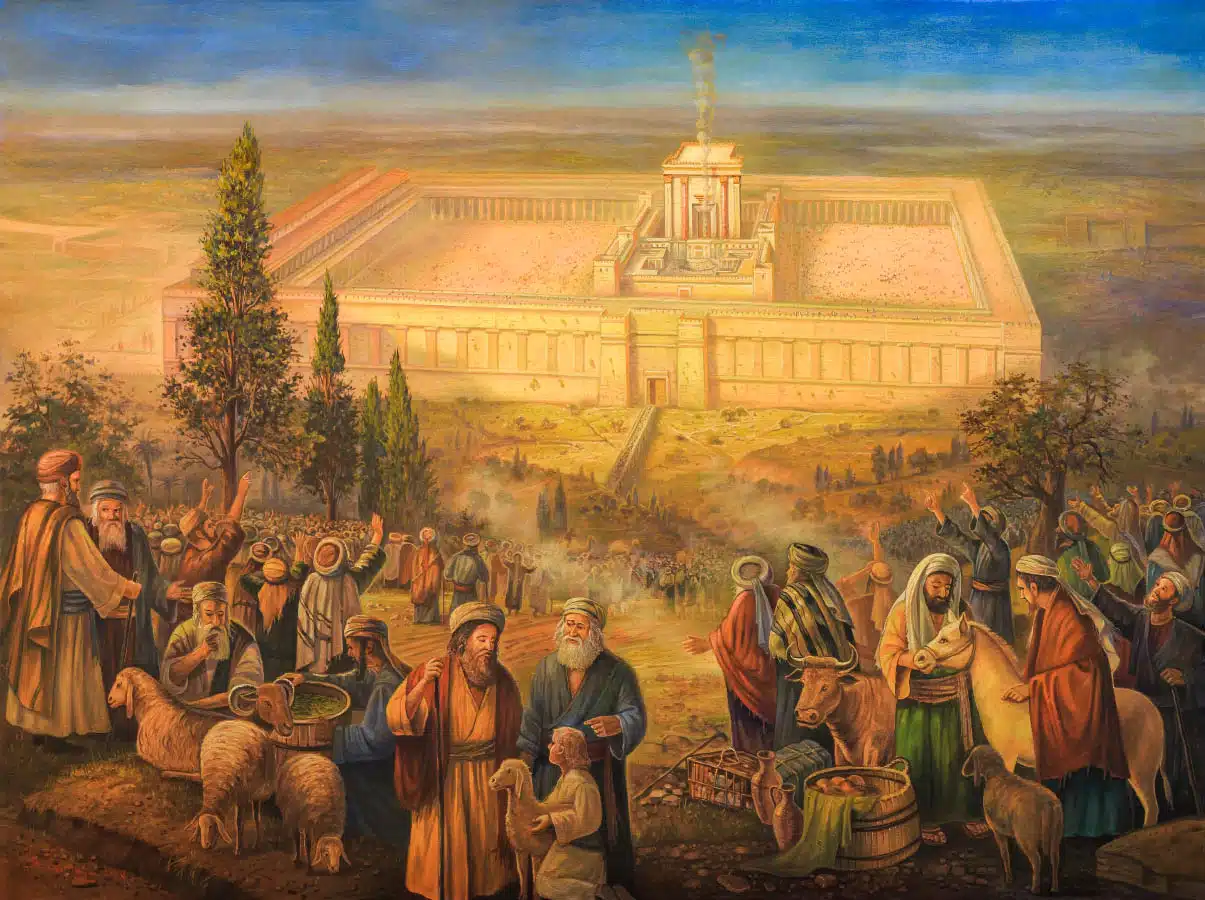
Build It and He Will Come!
Welcome back to this week’s “Getting Down to the Root” with D’vorah Calic. This week’s Torah portion is “Terumah.” There really is not a good English word to translate terumah. The best word is a voluntary offering or donation. Exodus 25:2 is the first place the word terumah is used and is in the context building the Tabernacle in the wilderness.
“The Lord said to Moses, ‘Speak to the people of Israel, that they take for me a voluntary offering. From every man whose heart moves him you shall receive the voluntary offering for me. And this is the voluntary offering that you shall receive from them: gold, silver, and bronze, blue and purple and scarlet yarns and fine twined linen, goats’ hair, tanned rams’ skins, goatskins, acacia wood, oil for the lamps, spices for the anointing oil and for the fragrant incense, onyx stones, and stones for setting, for the ephod and for the breastpiece. And let them make me a sanctuary, that I may dwell in their midst. Exactly as I show you concerning the pattern of the tabernacle, and of all its furniture, so you shall make it.’” (Exodus 25:1-9)
This is a very important Scripture, although most do not recognize it as such. What is “terumah”? It is a word which means a present which is offered up to God. It is implied that this is something given as a gift or tribute which is offered freely and willingly. It comes from another Hebrew word ruwm. This is an ancient word which means to raise up, to extol, to lift up or offer up.
There is a clear connection in the Scriptures between the terumah and the Dwelling Presence of The LORD. In Exodus 25, The LORD asks Moses to collect a voluntary offering called a terumah. According to verse 8, the reason is so that He can dwell in the midst of His people, Israel. The dwelling presence of God is referred to as the “Shekhinah” in Rabbinic literature. The word comes from the word “shakan” which means to dwell. It’s very interesting that shaken is also the modern-day Hebrew word for “neighbor.” This has the same letters but the vowel sound is different. This is a hint that the God of Israel desires to dwell with His people as their closest neighbor!
In our verse, the word for “sanctuary” is “mikdash,” which means a holy or sacred place, a sanctuary, a place set apart and consecrated to God. It is referring to the Mishkan or Tabernacle in the wilderness, but this would be the forerunner of the ultimate Beit HaMikdash or Temple in Jerusalem. It is this which our God has in mind. Another name for the Temple is the Beit HaMishkan and the word mishkan is the word for “tabernacle” used in Exodus 25:9. It implies the dwelling place or habitation of the Dwelling Presence, or as the Rabbis say, the Shekhinah.
In Exodus 25:8 it says, “They shall make a sanctuary (mikdash) so that I may dwell (v’shakhanti) among them (b’tokham). This word b’tokham comes from the word tavek meaning center, among, in the midst, or within. Rashi, the great French Rabbi of the Middle Ages, comments on the meaning of the verse: “Let them make to the glory of My Name a place of holiness.” The Italian Rabbi Sforno writes: “I will dwell among them permanently in order to receive their prayers and their sacrificial offerings in a manner similar to the way I displayed My presence at the mountain.” In a mysterious way, The LORD was saying something much more intimate. Sha’arei Orah which is a work that explains the mysteries of the nature of God says, “And sometimes this aspect [of the Dwelling Presence] is called Shekhinah, and it was dwelling [shokhenet] with Israel from the time of the making of the Mishkan, always, as it says "and they will make Me a Mikdash and I will dwell within them.”
Dear friends, I know this is a lot of Hebrew, but this is the point. This all fits beautifully with our understanding of the Messiah. Daniel Lancaster of First Fruits of Zion writes: “In a mystical way, Yeshua of Nazareth became a holy place, the mikdash of God, because the Almighty God appeared within Him, inhabited Him, and is reverenced in Him. God required a holy place in order to dwell among Israel.” Yeshua is described in Hebrews 7:26 as “holy, innocent, undefiled, separated from sinners and exalted above the heavens” (Torah Club v. 2, Shadows of the Messiah, First Fruits of Zion, 3rd Ed., pp. 441, 442). In Acts 3:14, He is called “the holy and righteous one.” These are descriptions which typically belong only to God Himself. At the beginning of the gospel of John, the highly mystical words help us to further see the Messiah as a tabernacle, a living mishkan, providing the Almighty One of Israel with a dwelling place, “The word was made flesh and dwelled in our midst (vayishkon be tocheinu). We have beheld his glory, like the glory of a father’s only son, great in kindness and truth (John 1:1:14)…For in Him, all the fullness of Deity dwells in bodily form (Colossians 2:9). We shouldn’t be surprised that the words in Hebrew for “and dwelled in our midst” in John 1:14 are the exact same words as in Exodus 25:8! And the same word for “dwells” in Colossians 2:9 is “shokhen.” This clearly connects the Torah’s mishkan and the Dwelling Presence of God resting within Yeshua in the New Testament! Though most of our translations say “among them”, isn’t it amazing that it is taught by our Jewish Sages along with our understanding of Messiah that The LORD actually desires to dwell within them? I hope you agree. This is why I am so passionate about studying the Bible from within a Jewish context, and my hope is to instill that passion in you also.
Well, let’s continue to learn about another important aspect of the Terumah. This Shabbat is also called Shabbat Shekelim to commemorate the collection of the Temple half-shekel. We need to jump ahead a bit to a verse in Parashat Ki Tisa. In Exodus 30:11-15, we find that the half-shekel offering is also called terumah. It is given when all the men from twenty years of age are numbered. Giving the half-shekel was the way to avoid counting people for it says in Exodus 30:11-13, “The LORD (The LORD) also spoke to Moses saying, ‘When you take a census of the sons of Israel to number them, then each one of them shall give a ransom (kofer) for himself to the LORD…This is what everyone who is numbered shall give: half a shekel according to the shekel of the sanctuary, half a shekel as a contribution (terumah) to the LORD.’”
The half-shekel is given for each of the fighting men of Israel, per head, and they counted the half-shekels rather than the people themselves, which was forbidden. It says in verse 15 that this “terumah” makes an atonement “kafar” for your souls. The root of “kafar” means to cover, purge, make reconciliation, make atonement. Rabbi Shapira has taught that this is an important hint that the giving of the half-shekel serves as a terumah to cover the man, the human being, to make reconciliation between the man and God, so the Shekhinah can live inside him. Therefore, the purpose of the terumah makes a type of covering for Israel so that they can live before God, and so that He can live among them. But His clear purpose was for the Shekhinah, Dwelling Presence of God, to live inside men.
In a few weeks, we will be in Parashat Vayakhel, where the command to take the terumah for the building of the Tabernacle is repeated in Exodus 35:5-36:6. Here it says, “Take from among you an offering (terumah) to the LORD; whoever is of a willing heart, let him bring it, an offering of the LORD; gold and silver, and bronze, and blue, and purple, and scarlet, and fine linen, and goats’ hair.”
The Torah is teaching us the importance of the Temple, and that it is built by all Israel together, whoever has a willing heart. There is another aspect of the Mishkan which we haven’t yet discussed, and that is the vibrant colors that are used in this very special, holy place. I won’t go into how they get the colors today, but just the symbolism behind them. Each color represents a specific group within Israel. The are colors are argamam, techelet, and tola’at. Argamam is purple, and its use has spread to the nations as well, because purple represents royalty. This color will have a significant role when Yeshua returns as Messiah, son of David. Argamam represents the kingship of Israel. Techelet is a specific color of blue, and there was one thread of techelet always used on the tzitzit (the fringes) of a man’s four-cornered garment. The tzitzit are an integral part of both a tallit katan, worn as an under garment and hanging out over the pants, and the tallit gadol, worn as a prayer shawl by Jewish men when they pray. The tzitzit was a reminder to keep the commandments of God. Techelet represents the office of the prophet of Israel, the one who was instrumental in bringing the people back to God. The third color is tola’at, and is called so because it comes from a special worm called tola’at. People often describe this color as red, but it is closer to the color of maroon. Tola’at represents the priesthood of Israel. So these colors teach us that the Mishkan is not only the place for the Shekhinah to dwell. The Mishkan is the place where the Shekhinah and Israel meet and dwell together. It’s the place where the Infinite meets the Finite.
Did you know that there will be a Temple in the Messianic Age? It is clearly spoken of by the Prophet Ezekiel. In fact, it is a principle in Judaism that the third and final Temple will be built by the Messiah Himself. In the Talmud, Tractate Sanhedrin 99a, it is written, “All the prophets prophesied all the good things for the Messianic Era.” This is referring to the days of Mashiach (Messiah), also known as the one-thousand-year reign of King Messiah on the earth. All of the Torah tells of the Mashiach and the days of Mashiach. Therefore, we can see the purpose of building the Mishkan is to teach us that the Shekhinah desires to live among His people, and He will once again during the Messianic Age. Importantly, the Hebrew also teaches us that He wants to live inside of each person. Each person is to become a little beit hamikdash.
How can that be? Because through Mashiach He lives within His people. The LORD is not confined to any particular physical space, but rather He dwells in the spaces between us, His people, and in our relationships between each other. While we are waiting for the Geulah (the final redemption), while we are waiting for Him to gather all of Israel together back to Jerusalem, we who know Messiah must build! We must each donate what we have been given, which is our part in the building of the Mishkan: our portion of the cover of the tent, our hooks, our planks, our pillars, our sockets, our partition curtain, our table, our utensils for the altar, our gold crown for the altar of incense, our pure oil. Do you see? All of us together, we are building the Mishkan, one large Mishkan for Him to dwell in. This is what it means to build the Kingdom, each of us contributing our part with a willing heart to the entire Mishkan. We are united together as a living mishkan. But also, Messiah will need a physical place to reign from. He has to have a holy place to return to where His throne will sit. This is one of the reasons the Temple will be rebuilt by Him and Israel during the Messianic Age. Yet, this does not negate the living temple we as people are meant to be now. I want to repeat what I said above. The LORD is not confined to any particular physical space, but rather He dwells in the spaces between us, His people, and in our relationships between each other. We build in the exile, so the exile can end. That is the purpose of the Mishkan. Look at what Ephesians 2:19-22 “….but you are fellow citizens with the holy ones and members of the household of God, built on the foundation of the apostles and prophets, Messiah Yeshua Himself being the cornerstone, in whom the whole structure, being joined together grows into a mishkan kadosh (a holy tabernacle) in the LORD. In Him you also are being built together into a dwelling place for God by the Spirit.” 1 Peter 2:5 says, “…you yourselves like living stones are being built up as a spiritual house, to be a holy priesthood, to offer spiritual sacrifices acceptable to God through Messiah Yeshua.” This is a metaphor to help us understand what we are to be doing while we wait for His return.
This is our purpose: together, we must build a place where The LORD can dwell, through Mashiach. We build by doing the mitzvot (commandments) of the Torah. We build a place for Him by doing the mitzvot together. This is what Adam was supposed to do in the garden. This is what Messiah did when He was on the earth. This is what Israel is to do. This is what we are to do. “And let us not grow weary of doing good, for in due season we will reap, if we do not give up.” (Galatians 6:9). Build it and He will come! Shabbat Shalom!
If you would like to learn more about Messianic Judaism, please visit our BlessIsraelNetwork.com website, where you can subscribe to our YouTube channel and our Facebook page. In addition, you can send me a private note on Facebook Messenger at https//:facebook.com/dvorah.calic.
Image Used with Permission; Painting by Alex Levin – https://artlevin.com